Crochet Granny Motif Baby Blanket Pattern
This post may contain affiliate links. If you buy through them we may earn a small commission at no extra cost to you. Learn more.
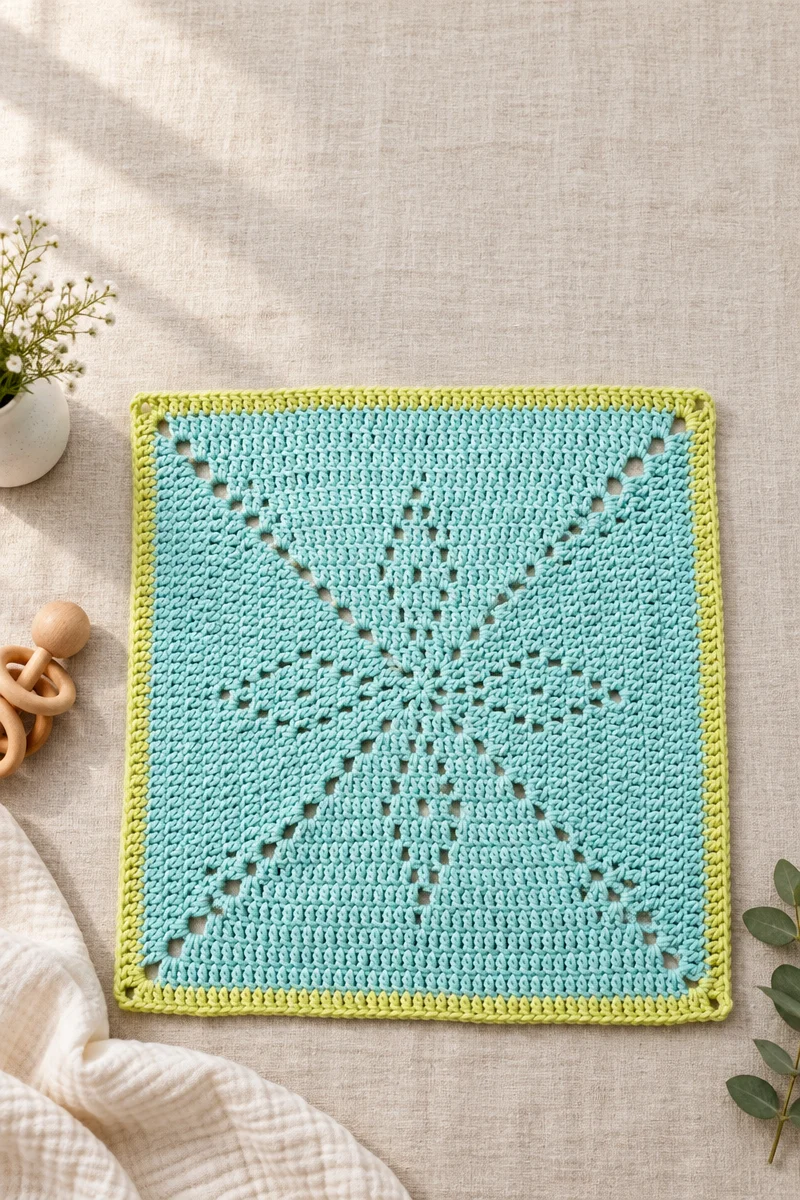
This soft granny motif blanket grows from a small center ring into a generous 33-inch square. Worked in plush Bernat Baby Blanket yarn, it combines simple double crochet rounds with clearly defined corner increases, making it a relaxing project for a nursery, stroller, lap, or baby shower gift.
Thank you for reading this post, don't forget to subscribe!Why you’ll love this pattern
- Simple repeating construction: After the center, each round follows the same basic square-building idea.
- Beginner-friendly practice: You’ll work double crochet, chain spaces, corner increases, and joined rounds.
- Soft and cozy texture: Bernat Baby Blanket yarn creates a thick, cuddly fabric that is especially suitable for baby projects.
- Portable project: The growing square is easy to take along once the center motif is established.
- A thoughtful handmade gift: The Seafoam and Lemon Lime palette has a fresh, cheerful look for a nursery or playroom.
- Quick visual progress: Each round noticeably enlarges the blanket, which makes the project satisfying to work.
“The rounds were easy to follow once I marked the corners. The blanket grew quickly, and the plush yarn made the finished square wonderfully soft.”
How this crochet blanket comes together
This granny motif blanket begins with a four-chain ring. The first rounds build a small center using double crochet stitches and chain-1 spaces. Corner groups made with 2 double crochet, chain 3, 2 double crochet create the square shape and provide room for increases.
Rounds 2 through 11 gradually expand the square. Rounds 12 through 14 continue the established pattern without detailed stitch counts: work double crochet across each side and place a corner increase in every chain-3 corner space.
The main color is Seafoam. Lemon Lime is joined for the edging, which is repeated until the blanket measures 33 inches (84 cm) square. The pattern is suitable for a confident beginner who understands basic crochet abbreviations and joined rounds. The completion time depends on tension and crochet speed.
Materials you’ll need
- Bernat® Baby Blanket™, 10.5 oz / 300 g; 220 yds / 201 m per ball
- Main Color (MC): Seafoam (04736), 2 balls or 440 yds / 400 m
- Contrast A: Lemon Lime (04223), 1 ball or 220 yds / 201 m
- Crochet hook: Susan Bates® Silvalume® U.S. N/13 (9 mm), or the size needed to obtain gauge
- Yarn needle for weaving in ends
- Optional: stitch markers and a measuring tape
Bernat Baby Blanket is a bulky, plush yarn designed for soft, cozy projects. If you substitute another yarn, choose a similar thick yarn and expect the blanket’s size, drape, texture, and yardage needs to change. Always make a gauge swatch if the finished size matters.
Step-by-step instructions
Abbreviations
- ch: chain
- dc: double crochet
- hdc: half double crochet
- sl st: slip stitch
- sp: space
- rnd: round
- beg dc: beginning double crochet
The instructions use joined rounds. Keep the work facing the same direction, and check that every corner is formed in a chain-3 space.
Build the center motif
-
With MC, ch 4. Join with a sl st to the first chain to form a ring.
-
First round: Ch 4; this counts as 1 dc and ch 1. Work (1 dc, ch 1) 6 times in the ring. Work 1 dc in the ring. Join.
-
Second round: Ch 3. Work 1 dc around the post of the joining hdc; this forms the beginning dc.
Repeat the following around the round: 1 dc in the next dc, ch 1, skip the next ch-1 space, 1 dc in the next dc, then (2 dc, ch 3, 2 dc) in the next ch-1 space.
Finish with 2 dc around the post of the joining hdc, ch 1, and join. -
Third round: Ch 3; this is the beginning dc.
Repeat around: 1 dc in each of the next 2 dc, ch 1, skip the next dc, 1 dc in the next ch-1 space, ch 1, skip the next dc, 1 dc in each of the next 2 dc, then (2 dc, ch 3, 2 dc) in the next ch-3 space.
Finish with 2 dc in the last ch-1 space, ch 1, and join. -
Fourth round: Ch 3; beginning dc.
Repeat around: 1 dc in each of the next 3 dc, ch 1, skip the next dc, 1 dc in the next ch-1 space, 1 dc in the next dc, 1 dc in the next ch-1 space, ch 1, skip the next dc, 1 dc in each of the next 3 dc, then (2 dc, ch 3, 2 dc) in the next ch-3 space.
Finish with 2 dc in the last ch-1 space, ch 1, and join. -
Fifth round: Ch 3; beginning dc.
Repeat around: 1 dc in each of the next 4 dc, ch 1, skip the next dc, 1 dc in the next ch-1 space, 1 dc in each of the next 3 dc, 1 dc in the next ch-1 space, ch 1, skip the next dc, 1 dc in each of the next 4 dc, then (2 dc, ch 3, 2 dc) in the next ch-3 space.
Finish with 2 dc in the last ch-1 space, ch 1, and join. -
Sixth round: Ch 3; beginning dc.
Repeat around: 1 dc in each of the next 5 dc, ch 1, skip the next dc, 1 dc in the next ch-1 space, 1 dc in each of the next 2 dc, ch 1, skip the next dc, 1 dc in each of the next 2 dc, 1 dc in the next ch-1 space, ch 1, skip the next dc, 1 dc in each of the next 5 dc, then (2 dc, ch 3, 2 dc) in the next ch-3 space.
Finish with 2 dc in the last ch-1 space, ch 1, and join. -
Seventh round: Ch 3; beginning dc.
Repeat around: 1 dc in each of the next 7 dc, 1 dc in the next ch-1 space, ch 1, skip the next dc, 1 dc in each of the next 2 dc, ch 1, skip the next dc, 1 dc in the next ch-1 space, 1 dc in each of the next 2 dc, ch 1, skip the next dc, 1 dc in each of the next 7 dc, then (2 dc, ch 3, 2 dc) in the next ch-3 space.
Finish with 2 dc in the last ch-1 space, ch 1, and join. -
Eighth round: Ch 3; beginning dc.
Repeat around: 1 dc in each of the next 10 dc, 1 dc in the next ch-1 space, ch 1, skip the next dc, 1 dc in each of the next 3 dc, ch 1, skip the next dc, 1 dc in the next ch-1 space, 1 dc in each of the next 10 dc, then (2 dc, ch 3, 2 dc) in the next ch-3 space.
Finish with 2 dc in the last ch-1 space, ch 1, and join. -
Ninth round: Ch 3; beginning dc.
Repeat around: 1 dc in each of the next 13 dc, 1 dc in the next ch-1 space, ch 1, skip the next dc, 1 dc in the next dc, ch 1, skip the next dc, 1 dc in the next ch-1 space, 1 dc in each of the next 13 dc, then (2 dc, ch 3, 2 dc) in the next ch-3 space.
Finish with 2 dc in the last ch-1 space, ch 1, and join. -
Tenth round: Ch 3; beginning dc.
Repeat around: 1 dc in each of the next 16 dc, 1 dc in the next ch-1 space, ch 1, skip the next dc, 1 dc in the next ch-1 space, 1 dc in each of the next 16 dc, then (2 dc, ch 3, 2 dc) in the next ch-3 space.
Finish with 2 dc in the last ch-1 space, ch 1, and join. -
Eleventh round: Ch 3; beginning dc.
Repeat around: 1 dc in each of the next 19 dc, 1 dc in the next ch-1 space, 1 dc in each of the next 19 dc, then (2 dc, ch 3, 2 dc) in the next ch-3 space.
Finish with 2 dc in the last ch-1 space, ch 1, and join. -
Rounds 12–14: Ch 3; beginning dc.
Work 1 dc in each dc to the next ch-3 space. Work (2 dc, ch 3, 2 dc) in that corner space. Repeat around the blanket, ending with 2 dc in the last ch-1 space. Ch 1 and join. -
At the end of the last round, join Contrast A. Break MC.
Work the edging
-
With A, ch 3; beginning dc.
-
Work 1 dc in each dc to the next ch-3 space. Work (2 dc, ch 3, 2 dc) in the corner space. Repeat around the blanket, ending with 2 dc in the last ch-1 space. Ch 1 and join.
-
Repeat the last edging round until the work measures 33 inches (84 cm) square.
-
Fasten off. Use the yarn needle to weave in all ends securely on the wrong side.
Ways to use your finished project
- Place it in a crib or nursery chair as a decorative baby blanket. Always follow current safe-sleep guidance and do not leave loose blankets with an unattended sleeping infant.
- Fold it over the back of a rocking chair or sofa for a soft accent.
- Use it as a stroller or car-seat cover only when an adult is supervising and airflow is not restricted.
- Give it as a baby shower, new-baby, or first-birthday gift.
- Pair it with a matching hat, lovey, or small accessory made in the same Seafoam and Lemon Lime palette.
- Photograph it flat with a neutral background if you plan to feature the finished blanket in a handmade shop listing.
How to care for your crochet project
Bernat Baby Blanket yarn is generally easy-care, but always check the label on your specific ball for the manufacturer’s instructions.
- Wash using the recommended machine setting and water temperature.
- Choose a gentle detergent and avoid harsh bleach.
- Do not wring or twist the blanket, as the heavy yarn can stretch when wet.
- Reshape the square while damp and dry it flat if the label permits.
- Avoid hanging the wet blanket from one edge.
- Keep it away from rough Velcro or abrasive surfaces that may encourage pilling.
- For storage, fold it loosely in a clean, dry place. Avoid compressing it for long periods.
- Check for color transfer the first time you wash contrasting colors together.
Tips for success
- Mark the corners: Place a stitch marker in each chain-3 corner space. This makes the increases easier to identify.
- Count the corners first: Every round should have four corner groups of 2 dc, ch 3, 2 dc.
- Keep the chain spaces visible: The ch-1 spaces are part of the structure. Missing one can make later rounds difficult to work.
- Watch your tension: Plush yarn can hide stitches. Work slowly and feel for the top loops when inserting the hook.
- Check the shape often: Lay the blanket flat after several rounds. If it cups, your tension may be too tight; if the edges ripple, you may have added stitches.
- Join consistently: Make each slip-stitch join in the same location so the seam remains neat.
- Use the correct hook: The listed 9 mm hook is a starting point. Use the size needed to obtain the intended gauge and fabric.
- Weave in ends securely: Plush yarn can be slippery, so weave each end through several stitches in more than one direction.
- Measure before finishing: Measure across the center and along the sides. Continue the edging until the blanket is square and reaches 33 inches.
Customize your project
- Change the main color: Replace Seafoam with cream, pale pink, soft gray, lavender, or another nursery-friendly shade.
- Use a stronger border contrast: Keep the center neutral and use a bright color for the edging to emphasize the square shape.
- Make a larger blanket: Continue repeating the edging round beyond 33 inches. This increases yarn requirements, weight, and working time.
- Make a smaller blanket: Stop earlier when the square reaches your preferred size. Purchase less yarn only after estimating the number of rounds needed.
- Create a coordinated set: Use the same two colors for a baby hat, security blanket, or cushion cover.
- Try a seasonal palette: Use warm autumn colors, icy winter shades, or pastel spring colors while keeping one color for the border.
- Add embroidery carefully: Simple initials or a small motif can personalize the blanket, but secure all threads firmly and avoid loose embellishments on baby items.
Changing yarn weight or fiber will affect the blanket’s thickness, drape, final measurements, and yarn consumption. A different hook size may also change the fabric and square dimensions.
Frequently asked questions
Is this granny motif blanket beginner-friendly?
Yes. It uses basic double crochet, chain spaces, slip-stitch joins, and corner increases. The later rounds are more repetitive, but beginners should check the corner placement carefully.
How much yarn do I need?
The pattern calls for 440 yards (400 m) of Seafoam and 220 yards (201 m) of Lemon Lime. That equals two balls of the main color and one ball of the contrast color in the specified Bernat Baby Blanket yarn.
Can I use a different hook size?
Yes, but the hook size affects tension, fabric thickness, and finished size. Use the size needed to obtain gauge. A smaller hook creates a denser fabric, while a larger hook creates a looser fabric.
How can I make the blanket larger?
Continue repeating the edging round until the blanket reaches the desired size. Buy additional yarn before beginning, because a larger blanket requires more yardage and becomes heavier.
Why is my blanket curling or cupping?
A small amount of movement can happen while crocheting, but persistent cupping usually indicates tight tension or missed corner increases. Rip back to the last correct round, verify all four corners, and try loosening your tension.
How do I keep the edges even?
Place every corner group in the chain-3 corner space and work the same number of double crochet stitches across each side. Stitch markers make the corners much easier to locate.
Can I wash the finished blanket?
Follow the care instructions on the yarn label. Use gentle handling, avoid wringing, and reshape the blanket while damp. Dry it flat when recommended.
Can I sell blankets made from this pattern?
The supplied pattern information does not state the designer’s terms for selling finished items. Check the original pattern source or designer’s usage policy before listing or selling blankets made from it.