How to Read a Crochet Pattern (Beginner’s Guide + Cheat Sheet)
Crochet patterns finally make sense. Learn abbreviations, brackets, asterisks, stitch counts, gauge and US vs UK terms — explained in plain language with examples.
- Skill level
- Beginner
- Time
- 10-minute read
This post may contain affiliate links. If you buy through them we may earn a small commission at no extra cost to you. Learn more.
The first time you open a crochet pattern it can look like a secret code: Rnd 3: (sc, inc) x6 [18]. The good news is that every pattern uses the same small set of conventions. Learn them once and you can read almost any pattern — including all of ours.
Thank you for reading this post, don't forget to subscribe!1. Start with the pattern header
Before any stitches, a good pattern tells you:
- Skill level — Beginner, Easy, Intermediate or Advanced.
- Materials — yarn weight and amount, hook size, notions like stuffing or buttons.
- Gauge — how many stitches and rows fit in 4 in (10 cm).
- Finished size — so you know what you’ll end up with.
- Terms — US or UK. This matters a lot (see below).
Tip: Read the whole pattern once before you start. Many “mistakes” are explained in the notes section.
2. Learn the core abbreviations
These cover the vast majority of patterns.
| Abbreviation | Stitch / meaning |
|---|---|
| ch | chain |
| sl st | slip stitch |
| sc | single crochet |
| hdc | half double crochet |
| dc | double crochet |
| tr | treble crochet |
| inc | increase (2 stitches in one stitch) |
| dec / sc2tog | decrease (2 stitches worked together into one) |
| MR | magic ring |
| BLO / FLO | back loop only / front loop only |
| sk | skip |
| sp / ch-sp | space / chain space |
| st(s) | stitch(es) |
| RS / WS | right side / wrong side |
| rep | repeat |
3. US vs UK terms
US and UK patterns use the same names for different stitches. If your project looks far too tall or too short, check this first.
| US term | UK term |
|---|---|
| slip stitch (sl st) | slip stitch (ss) |
| single crochet (sc) | double crochet (dc) |
| half double crochet (hdc) | half treble (htr) |
| double crochet (dc) | treble (tr) |
| treble (tr) | double treble (dtr) |
All YarnPurls patterns use US terms.
4. Rows vs rounds
- Row — you work back and forth and turn at the end. Used for blankets, scarves, flat panels.
- Rnd (round) — you work in a circle without turning. Used for hats, amigurumi, coasters.
- Joined rounds — each round ends with a sl st into the first stitch.
- Spiral (continuous) rounds — you go straight into the next round. Use a stitch marker to mark the first stitch.
5. Brackets, asterisks and repeats
This is where most beginners get stuck, but the logic is simple.
Parentheses ( ) with a number: repeat what’s inside that many times.
(Sc, inc) x6 → sc in the next stitch, increase in the next stitch — do that 6 times.
Asterisks *: repeat from the asterisk as instructed.
Ch 3, *dc in next st, ch 1, sk next st* — repeat from * around. → after the ch 3, keep repeating the part between the asterisks until you reach the end of the round.
Brackets [ ] at the end of a line: the stitch count — how many stitches you should have when that row or round is done.
Rnd 3: (sc, inc) x6. [18] → you should have 18 stitches.
Stitches worked into one place: (2 dc, ch 2, 2 dc) in next ch-sp means all of those stitches go into the same space — common in granny squares.
6. Turning chains
At the start of a row you chain a few stitches to bring your hook up to the height of the next row:
| Stitch | Usual turning chain |
|---|---|
| sc | ch 1 |
| hdc | ch 2 |
| dc | ch 3 |
| tr | ch 4 |
The pattern notes will say whether the turning chain counts as a stitch. This changes your stitch count, so it’s worth checking.
7. Gauge, explained simply
Gauge is the number of stitches and rows in a 4 in (10 cm) square. If a pattern says 14 hdc and 10 rows = 4 in, here’s how to check:
- Crochet a swatch about 5–6 in square in the stitch given.
- Lay it flat (block it if the pattern says so).
- Count stitches across 4 in in the middle of the swatch.
- Too many stitches? Your tension is tight — go up a hook size.
- Too few stitches? Your tension is loose — go down a hook size.
8. Common phrases decoded
| Phrase | What it means |
|---|---|
| Work even | Continue without increasing or decreasing |
| Fasten off | Cut the yarn and pull it through the last loop |
| Leave a long tail | Keep 12–20 in of yarn for sewing later |
| Join | Slip stitch into a stitch to close a round |
| Turn | Flip your work to crochet back along the row |
| In the same st | Work into the stitch you just worked into |
| Evenly | Spread the stitches out as uniformly as you can |
9. Your step-by-step routine
- Read the whole pattern, including notes.
- Check the terms (US/UK) and the abbreviations list.
- Gather materials and make a gauge swatch if fit matters.
- Use stitch markers liberally.
- Count stitches at the end of every row or round — compare to the number in brackets.
- Tick off rows on a printed copy (every YarnPurls pattern has a Print button).
Practice patterns to try next
Once you’re comfortable, try these beginner-friendly patterns:
- Round crochet coasters — your first rounds and increases.
- Easy crochet pumpkin — rows and back-loop ribbing.
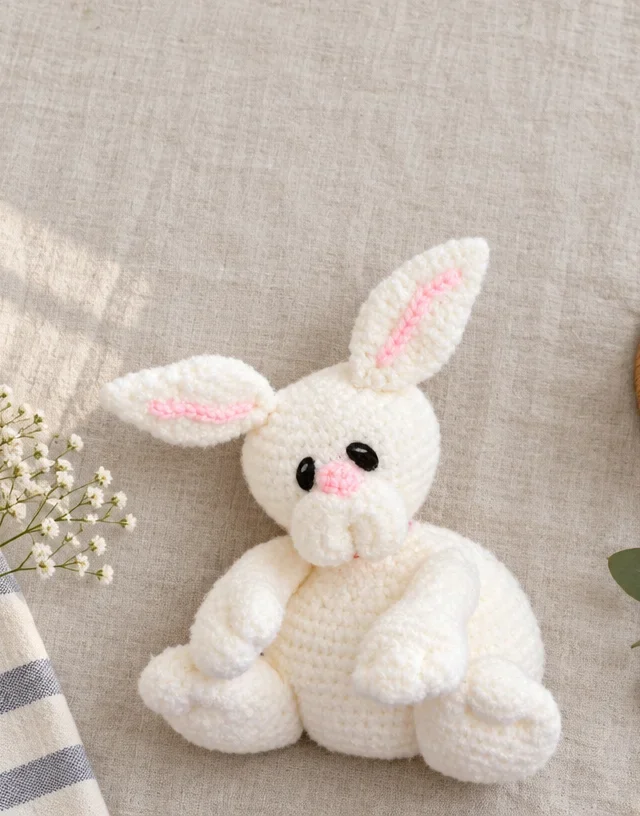
- Crochet bunny amigurumi — spiral rounds, increases and decreases.
Bookmark this page — it’s the cheat sheet you’ll come back to again and again.
Frequently asked questions
What’s the difference between US and UK crochet terms?
The stitch names are shifted by one. A US single crochet is a UK double crochet, a US double crochet is a UK treble, and so on. Always check which terms a pattern uses before you start.
What does “work even” mean?
It means to keep working the same stitch in each stitch around or across without increasing or decreasing.
Do I really need to make a gauge swatch?
For blankets, coasters and decor, usually not. For anything that has to fit — hats, sweaters, socks — yes. It’s the only way to know your finished size will match the pattern.