Crochet Blanket Pattern: Big Florals
This post may contain affiliate links. If you buy through them we may earn a small commission at no extra cost to you. Learn more.
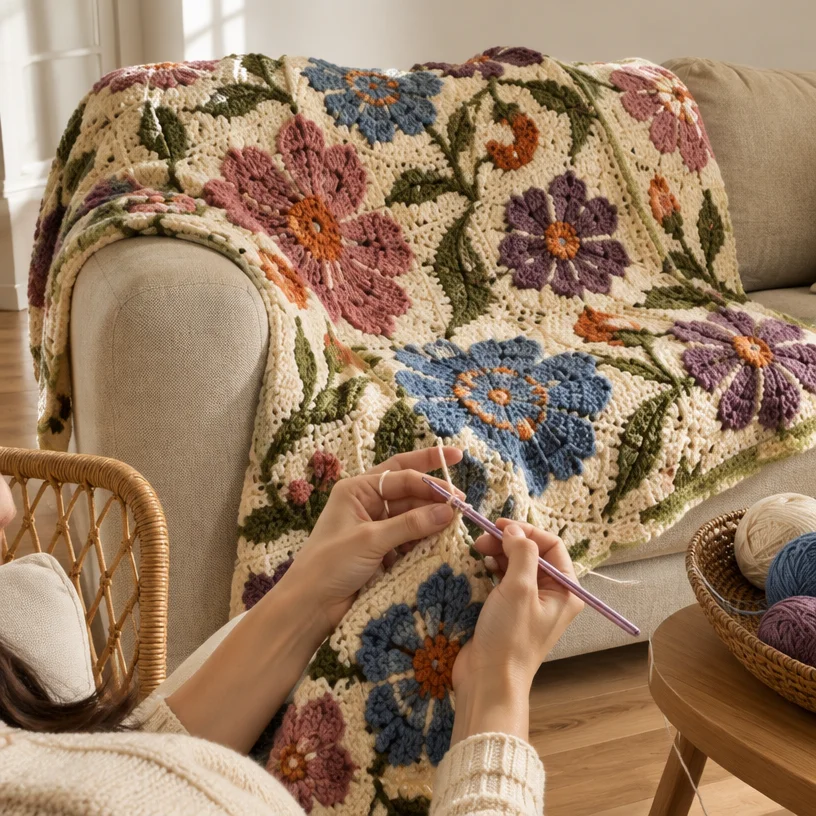
The Big Florals crochet blanket is a cheerful corner-to-corner project built from colorful blocks that form a bold floral design. It is an enjoyable make for crocheters who like chart-based patterns, color changes, and the satisfying rhythm of working one block at a time. Use it as a cozy throw, a bright accent for a bedroom, or a handmade gift for someone who loves expressive home décor.
Thank you for reading this post, don't forget to subscribe!Why You’ll Love This Pattern
- Striking floral design: The chart creates large, graphic flowers with plenty of visual impact.
- Useful colorwork practice: You will learn to manage multiple color sections and change colors neatly.
- Relaxing construction: Once the chart rhythm is established, the repeated blocks create a steady crochet flow.
- Portable progress: Smaller sections can be taken along for travel or evening crocheting.
- Decorative and practical: The finished blanket adds warmth and personality to a sofa, chair, or bed.
- Meaningful gift potential: A handmade floral blanket makes a thoughtful wedding, birthday, housewarming, or holiday present.
“The chart looked intimidating at first, but the block construction made it much easier to follow. The color changes really bring the flowers to life, and the cream background gives the blanket a polished finish.”
How This Crochet Blanket Comes Together
This blanket is worked diagonally from corner to corner using a block-based technique. Each square on the chart represents one crochet block, so the chart controls both the shape and the floral color placement.
The project begins with a single block. The first section increases across the rows until the 70th row contains 70 blocks. You then work the sides evenly, followed by a gradual decrease that brings the blanket back to one final block.
The design uses double crochet blocks separated by chain spaces. Because the blanket is chart-based, careful color tracking is more important than complicated stitch work. The pattern is best suited to an intermediate crocheter, although a confident beginner familiar with double crochet and color changes can also attempt it.
The total time depends on your crochet speed, tension, and experience with colorwork. Allow extra time for winding small color balls, managing yarn ends, and adding the two-round edging.
Materials You’ll Need
Yarn
- Bernat® Lattice™, 7.8 oz/220 g; 389 yds/356 m per ball
- Contrast A Cream (19013): 8 balls, or 3,065 yds/2,803 m
- Contrast B Loden Mix (19009): 2 balls, or 465 yds/425 m
- Contrast C Ocean Blues (19011): 1 ball, or 55 yds/50.5 m
- Contrast D Rust Mix (19007): 1 ball, or 35 yds/32 m
- Contrast E Cherry (19006): 1 ball, or 100 yds/91.5 m
- Contrast F Heather Mix (19012): 1 ball, or 45 yds/41 m
Tools
- U.S. H/8, 5 mm Susan Bates® Silvalume® crochet hook, or the size needed to obtain gauge
- Susan Bates® yarn needle
- Scissors
- Optional: small yarn bobbins, clips, or separate yarn bags for managing color sections
The listed yarn gives the blanket its intended color arrangement, texture, and drape. If you substitute yarn, choose a similar weight and check your gauge. A different yarn weight can change the blanket’s size, thickness, and yardage requirements.
Step-by-Step Instructions
Before You Begin
The blanket is worked diagonally from corner to corner.
When following the chart:
- Each square represents one block.
- Wind small balls of each color needed for separate color areas.
- Start each new color at the indicated point in the chart.
- To change color, work until 2 loops remain on the hook. Yarn over with the new color and pull through both loops to complete the stitch. Continue with the new color.
- Keep checking the chart as you work. Correcting a color mistake early is much easier than unraveling several rows later.
The pattern refers to a beginning block, or beg block, and a standard block.
Starting Chain
With Contrast A, chain 6.
Refer to the crochet diagram and blanket chart while working the design.
Build the First Section
-
Row 1, right side:
Make 1 double crochet in the fourth chain from the hook; this counts as 2 double crochets. Make 1 double crochet in each of the last 2 chains. Turn.
You now have 1 block. -
Row 2:
Chain 6. Make 1 double crochet in the fourth chain from the hook. Make 1 double crochet in each of the next 2 chains to complete the beginning block.
In the next chain-3 space, work: slip stitch, chain 3, and 3 double crochets. This makes the next block. Turn.
You now have 2 blocks. -
Row 3:
Make a beginning block.
Work 1 block in the next chain-3 space. Repeat this instruction to the end of the row. Turn.
You now have 3 blocks. -
Continue increasing in the same block pattern. Follow the chart carefully for every color change.
-
Repeat the last row pattern until the 70th row of the chart is complete. The 70th row contains 70 blocks.
Work the Sides Evenly
-
Row 71:
Slip stitch in each of the first 3 double crochets.
Work 1 block in the next chain-3 space. Repeat from the asterisk to the end of the row. Turn. -
Row 72:
Make a beginning block.
Work 1 block in the next chain-3 space. Repeat until the last chain-3 space. Slip stitch in the last chain-3 space; do not make a block there. Turn. -
Rows 73–90:
Repeat Rows 71 and 72 nine more times.
These rows maintain the blanket’s width while continuing the charted color design.
Decrease Toward the Final Corner
-
Row 91:
Slip stitch in each of the first 3 double crochets.
Work 1 block in the next chain-3 space. Repeat until the last chain-3 space. Slip stitch in the last chain-3 space. Do not make a block there. Turn. -
Continue repeating Row 91 until only 1 block remains, keeping the color changes consistent with the chart.
-
Fasten off when the final block is complete.
Add the Edging
-
Turn the blanket so the right side is facing you. Join Contrast A with a slip stitch to any corner.
-
First round:
Chain 3; this counts as 1 double crochet.
Work double crochet evenly around the blanket, making 5 double crochets in each corner. Join with a slip stitch to the top of the beginning chain 3. -
Second round:
Chain 3. Make 1 double crochet in each double crochet around. Work 5 double crochets in each corner double crochet. Join with a slip stitch to the top of the beginning chain 3. -
Fasten off. Weave in all ends securely with a yarn needle.
Ways to Use Your Finished Blanket
- Drape it over a sofa or reading chair as a colorful accent.
- Fold it at the foot of a bed for extra warmth and decoration.
- Use it as a cozy lap blanket during cool evenings.
- Give it as a handmade housewarming or wedding gift.
- Pair it with coordinating cushions or solid-color throws.
- Display it in a guest room to add a welcoming handmade touch.
- Photograph it with neutral furniture so the floral chart remains the main feature.
Because the design is bold, it works especially well with simple surrounding décor and solid-colored accessories.
How to Care for Your Crochet Blanket
Check the yarn label before washing, as the correct care method depends on the fiber content and manufacturer’s instructions.
For gentle maintenance:
- Wash according to the yarn-label directions.
- Use cool or lukewarm water and a mild detergent when hand washing is recommended.
- Avoid twisting or wringing the blanket, which can stretch the diagonal construction.
- Press out excess water gently, preferably by rolling the blanket in a clean towel.
- Reshape the blanket while damp and dry it flat.
- Keep it away from direct heat and prolonged sunlight.
- Do not hang the wet blanket, since its weight may pull the stitches out of shape.
- Store it clean and fully dry in a breathable cupboard or fabric storage bag.
- Avoid storing it tightly compressed for long periods to reduce creasing and possible pilling.
If the blanket becomes uneven after washing, gently reshape it while damp rather than pulling aggressively on the edges.
Helpful Crochet Tips
- Use a chart marker: Place a removable marker beside the row you are currently working to avoid losing your position.
- Track every color area: Wind separate small balls for isolated sections. This prevents long strands from traveling across the back of the work.
- Check the right side: Colorwork can become confusing when the blanket is turned. Confirm the right-side row before changing colors.
- Watch the final loops: Make each color change while 2 loops remain on the hook so the new shade is securely incorporated.
- Count blocks, not only stitches: The chart is organized by blocks. Counting the blocks at the end of a row helps catch accidental increases or skipped spaces.
- Keep the tension consistent: Tight blocks can make the blanket stiff, while loose blocks can create uneven edges.
- Do not skip the slip stitch at a decrease: The slip stitch removes the final block and keeps the corner shaping correct.
- Secure yarn ends as you go: With several shades, weaving in some ends during the project makes finishing much less overwhelming.
- Use the edging to refine the shape: Work the double crochets evenly. If the edge ripples, you may be adding stitches too frequently; if it pulls inward, the spacing may be too tight.
- Block gently if needed: Light blocking can improve the shape, but avoid stretching the blanket beyond its natural proportions.
Customize Your Crochet Blanket
Change the Color Palette
Keep Cream as the background and replace the floral shades with colors that suit your room. Soft pastels create a spring-inspired blanket, while jewel tones produce a richer look. Changing the colors should not significantly affect the size if you use the same yarn weight and maintain the same tension.
Use a Contrasting Border
The original edging uses Contrast A. For a stronger frame, use one of the darker floral shades for both edging rounds. A darker border can make the central chart appear more defined.
Adjust the Size
To make a smaller or larger blanket, you can modify the chart or repeat fewer or additional diagonal sections. However, changing the chart dimensions affects the floral motif, proportions, and yarn requirements. You will also need additional yarn for a larger version, especially for the background color.
Try a Seasonal Palette
- Red, green, and cream for a festive winter throw
- Orange, gold, and rust for an autumn version
- Lavender, pink, and sage for a soft spring design
- Blue, white, and gray for a cool coastal palette
Add Coordinating Accessories
Use the same color palette to make cushion covers, smaller lap blankets, or decorative pillow fronts. Keep the yarn weight and gauge consistent if you want the pieces to coordinate closely.
Avoid very textured or novelty yarns in the charted sections unless you are comfortable with reduced stitch visibility. Fuzzy yarn can make block placement and color changes difficult to read.
Frequently Asked Questions
Is this crochet blanket beginner-friendly?
It is most suitable for an advanced beginner or intermediate crocheter. The stitches are straightforward, but the diagonal construction, chart reading, and multiple color changes require concentration.
What stitch is used for the blanket?
The blanket is made from double crochet blocks separated by chain spaces. Slip stitches are used to move across the blocks and shape the edges.
How many blocks are in the widest row?
The 70th row contains 70 blocks. This is the point where the increasing section is complete before the blanket proceeds through the even and decreasing sections.
Can I use a different crochet hook?
Yes, but the hook size may affect the finished dimensions and drape. Use the hook size that gives the required gauge. A larger hook usually creates a looser, larger fabric, while a smaller hook creates a denser, smaller fabric.
How much yarn do I need?
You need 8 balls of Contrast A, 2 balls of Contrast B, and 1 ball each of Contrasts C, D, E, and F. The total listed yardage is 3,765 yds/3,442.5 m.
How do I manage all the color changes?
Wind small balls of yarn for each separate color area shown in the chart. Keep them organized in individual bags or bowls, and change colors when 2 loops remain on the hook.
Why are my blanket edges uneven?
Uneven edges are usually caused by missed blocks, accidental extra blocks, inconsistent tension, or incorrect slip stitches at the row ends. Count the blocks regularly and compare each completed row with the chart.
How can I make the blanket larger?
You can enlarge the chart or add more diagonal sections, but this will change the floral arrangement and increase yarn usage. The Cream background will usually require the largest additional amount.
Can I sell a blanket made from this pattern?
The source instructions do not state the designer’s selling or licensing terms. Check the original pattern publisher’s usage policy before selling finished items made from the design.
How should I wash the finished blanket?
Follow the care instructions on the Bernat® yarn label. Use gentle handling, avoid wringing, reshape the blanket while damp, and dry it flat unless the label gives different instructions.