Airy Crochet Baby Blanket Pattern for Beginners
This post may contain affiliate links. If you buy through them we may earn a small commission at no extra cost to you. Learn more.
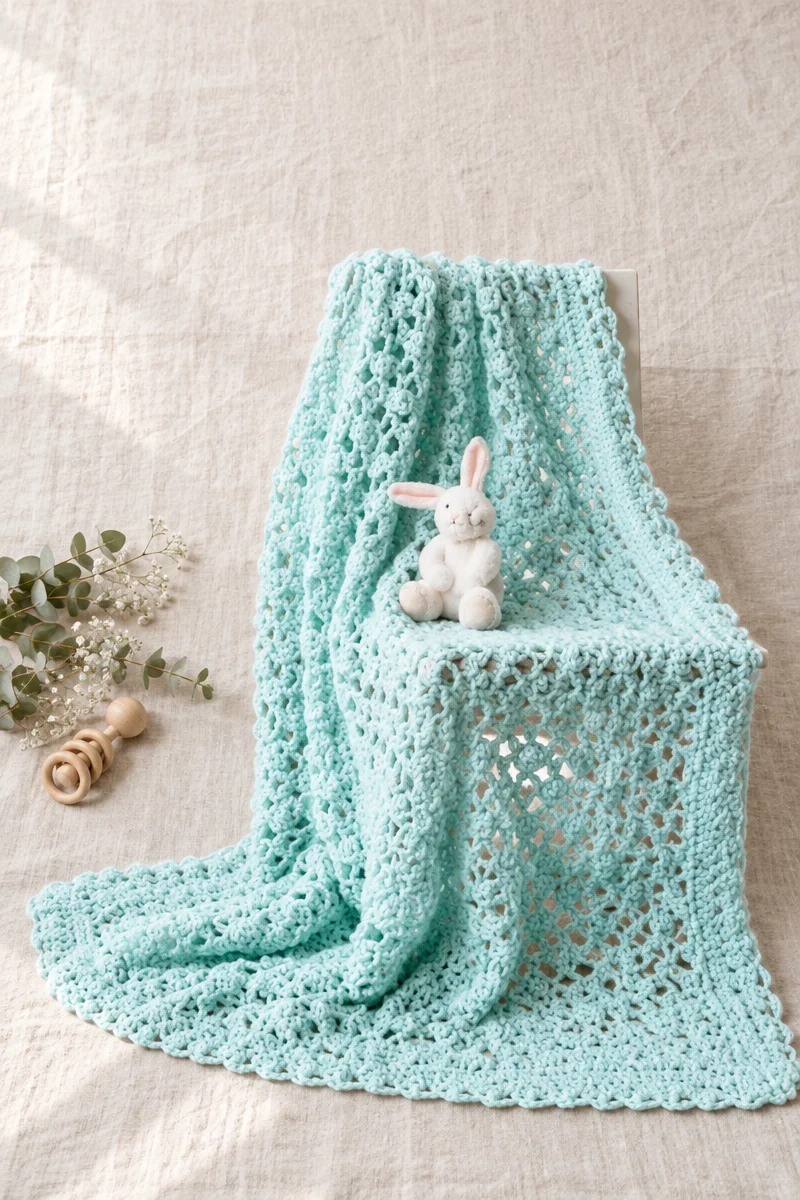
This airy crochet baby blanket has an open lace-inspired texture, a soft drape, and a delicate cluster stitch that gives the fabric plenty of visual interest without making it heavy. The repeating four-row pattern is relaxing once established, making this a lovely project for a thoughtful baby-shower gift, nursery accessory, or quiet weekend of crochet.
Thank you for reading this post, don't forget to subscribe!Why you’ll love this pattern
- Lightweight and breathable: The open chain spaces create an airy fabric that works well for a baby blanket.
- A useful stitch-building project: You’ll practice chain spaces, single crochet, double crochet, and three-part clusters.
- Easy to memorize: The body repeats Rows 2 to 5, so the design becomes more familiar as you work.
- Gift-friendly: Mint, white, pink, pale blue, and lemon all suit a classic baby palette.
- Relaxing to crochet: Much of the blanket is made with repeated openwork rows, making it portable and enjoyable for steady stitching.
- Finished with a decorative border: Three edging rounds frame the open body with a fuller, more polished finish.
“The lace pattern looks much more complicated than it is. After a few repeats, I could crochet the rows from memory, and the finished blanket felt soft, light, and beautifully delicate.”
How this crochet pattern comes together
You’ll begin with a foundation chain of 138 stitches and work the blanket flat in rows. The first row creates a series of chain-5 spaces separated by single crochet stitches. The following rows build the openwork design and place a three-part cluster in alternating positions.
The body repeats Rows 2 through 5 until it measures approximately 37 inches (94 cm), ending on a wrong-side row. A three-round border is then worked around all four sides:
- A fuller double crochet round creates the foundation of the edging.
- A chain-1 and double crochet round adds a light openwork effect.
- A final single crochet and cluster round completes the decorative edge.
The pattern uses basic stitches but requires careful attention to chain spaces and stitch placement. It is suitable for an adventurous beginner or intermediate crocheter. Completion time will vary according to your tension and crochet speed.
Materials you’ll need
- Bernat® Softee® Baby™, 5 oz/140 g; 362 yds/321 m per ball
- Mint (02004): 3 balls
- Or White (02000), Pink (02001), Pale Blue (02002), or Lemon (02003)
- Size U.S. G/6 (4 mm) crochet hook, or the size needed to obtain gauge
Optional but helpful:
- Tapestry needle for weaving in ends
- Measuring tape
- Stitch markers
- Rust-resistant pins and a flat surface for blocking
Bernat Softee Baby is a soft baby yarn with enough yardage for this project. If you substitute yarn, choose a similar lightweight yarn and make a gauge swatch first. A thicker yarn will create a heavier, larger-looking blanket and may require more yarn; a thinner yarn will produce a lighter, smaller fabric.
Step-by-step instructions
Abbreviations
- ch: chain
- sc: single crochet
- dc: double crochet
- sl st: slip stitch
- sp: space
- st: stitch
- rep: repeat
- WS: wrong side
- yoh: yarn over hook
Crochet the blanket body
-
Foundation chain: Chain 138.
-
Row 1, wrong side: Work 1 single crochet in the second chain from the hook.
Chain 5, skip the next 3 chains, and work 1 single crochet in the next chain.
Repeat from the asterisk to the end of the chain. Turn. -
Row 2: Chain 5.
Work 1 single crochet in the next chain-5 space. Chain 2. In the next stitch, work the following three times: yarn over and draw up a loop, yarn over and draw through 2 loops on the hook. Yarn over and draw through all loops on the hook to complete the cluster. Chain 2. Work 1 single crochet in the next chain-5 space. Chain 5.
Repeat from the asterisk across, ending with 1 single crochet in the last chain-5 space. Chain 2, then work 1 double crochet in the last single crochet. Turn. -
Row 3: Chain 1. Work 1 single crochet in the first double crochet.
Chain 5, work 1 single crochet in the next cluster, chain 5, and work 1 single crochet in the next chain-5 space.
Repeat from the asterisk across, ending with 1 single crochet in the last turning chain-5 space. Turn. -
Row 4: Chain 5.
Work 1 single crochet in the next chain-5 space. Chain 5. Work 1 single crochet in the next chain-5 space. Chain 2. Work a cluster in the next single crochet. Chain 2.
Repeat from the asterisk across, ending with 1 single crochet in the next chain-5 space. Chain 2, then work 1 double crochet in the last single crochet. Turn. -
Row 5: Chain 1. Work 1 single crochet in the first double crochet.
Chain 5, work 1 single crochet in the next chain-5 space, chain 5, and work 1 single crochet in the next cluster.
Repeat from the asterisk across, ending with chain 5, 1 single crochet in the next chain-5 space, chain 5, and 1 single crochet in the last turning chain-5 space. Turn. -
Repeat the body pattern: Repeat Rows 2 through 5 until the work measures approximately 37 inches (94 cm) from the beginning. End on a wrong-side row.
Work the edging
The edging is worked around all four sides of the blanket.
Edging Round 1
- Chain 3, then work 4 double crochet in the first single crochet.
- Work 3 double crochet in the next chain-5 space, then 1 double crochet in the next single crochet. Repeat from the asterisk across, working 5 double crochet in the last single crochet.
- Along the side edge, work 3 double crochet in the side of each turning chain and 1 double crochet in the side of each single crochet.
- Work 5 double crochet in the corner.
- Along the foundation edge, work 3 double crochet in the next chain-3 space, then 1 double crochet in the remaining loop below the single crochet.
- Repeat the foundation-edge sequence across, working 5 double crochet in the last single crochet.
- Work up the second side edge, placing 3 double crochet in the side of each turning chain and 1 double crochet in the side of each single crochet.
- Join with a slip stitch to the top of the beginning chain 3.
Edging Round 2
- Chain 4. Work 1 double crochet in the next double crochet.
- Work (chain 1, 1 double crochet in the next double crochet) twice.
- Chain 1, skip the next double crochet, and work 1 double crochet in the next double crochet. Repeat from the asterisk to the next corner containing 5 double crochet.
- At the corner, work (chain 1, 1 double crochet in the next double crochet) 4 times.
- Repeat the section from step 3 through step 4 twice more around the blanket.
- Continue with chain 1, skip the next double crochet, and work 1 double crochet in the next double crochet to the end of the round.
- End with chain 1 and skip the last double crochet. Join with a slip stitch to the third chain of the beginning chain 4.
Edging Round 3
- Chain 1, then work 1 single crochet in the same space as the last slip stitch.
- Chain 2, skip the next chain-1 space, work a cluster in the next double crochet, chain 2, skip the next chain-1 space, and work 1 single crochet in the next double crochet.
- Repeat from the asterisk around the blanket.
- End with chain 2, skip the last chain-1 space, and join with a slip stitch to the first single crochet.
- Fasten off.
Finishing
Fasten off securely and weave in all loose ends with a tapestry needle. For the neatest finish, weave each end back and forth through several stitches on the wrong side before trimming. Lightly block the blanket if needed to even the openwork and straighten the border.
Ways to use your finished project
- Give it as a baby-shower or newborn gift.
- Fold it over the back of a nursery rocking chair.
- Use it as a lightweight stroller or car-seat blanket while supervising the baby.
- Layer it at the foot of a crib or bassinet for decorative purposes, following safe-sleep guidance and keeping loose blankets away from sleeping infants.
- Photograph it with milestone cards or newborn props.
- Make coordinating blankets in white, mint, pale blue, pink, or lemon for a handmade nursery collection.
- Offer completed blankets at craft fairs or in a handmade shop, provided you follow the original pattern designer’s usage terms.
How to care for your crochet project
Check the yarn label before washing. For Bernat Softee Baby, use gentle handling and avoid high heat.
- Wash according to the yarn-label instructions, preferably using a gentle cycle or hand washing.
- Use cool or lukewarm water and a mild detergent.
- Avoid bleach and harsh fabric softeners.
- Do not wring or twist the blanket, as the open chain spaces can stretch.
- Gently squeeze out excess water and reshape the blanket while damp.
- Dry flat on a clean towel or drying surface.
- If blocking, pin the blanket gently without stretching the lace openings too far.
- Store it clean and completely dry, folded loosely in a breathable container.
- Keep dark or strongly dyed items separate from pale colors during the first wash to reduce the risk of color transfer.
Helpful crochet tips
- Count the foundation chain carefully. A foundation of 138 chains helps establish the intended width and repeat.
- Keep your chain tension relaxed. Tight chain-5 spaces can make the blanket stiff and reduce its airy drape.
- Identify each cluster clearly. The cluster is made by partially completing three stitches and drawing through all remaining loops together.
- Watch the turning chains. The chain-5 and chain-2 finishes help keep the side edges aligned. Missing one can cause the blanket to narrow or widen.
- Use stitch markers at the edges. Place one in the first and last working stitch of a row while you become familiar with the pattern.
- Check the fabric every few rows. Lay the blanket flat and look for consistent chain-5 spaces and evenly spaced clusters.
- Do not pull the border too tightly. A tight edging can cause the blanket to curl.
- Work side-edge stitches evenly. When making the first edging round, use the turning chains and single crochet side stitches as instructed rather than guessing a fixed number.
- Block gently. Blocking can improve the shape, but excessive stretching may distort the openwork.
Customize your project
- Change the color: Mint, white, pink, pale blue, and lemon create different nursery styles. White gives a classic look, while mint and lemon feel fresh and modern.
- Add a contrasting border: Work the blanket body in one shade and the edging in another. This will require changing color at the start of the edging.
- Adjust the width: Modify the foundation chain in multiples that preserve the repeating structure. Because the original instructions do not state a formal repeat multiple, make a small swatch before committing to a new foundation length.
- Adjust the length: Repeat or stop the four-row body sequence at a different measurement. Always end the body on a wrong-side row before beginning the edging.
- Use a different yarn: A similar lightweight yarn can work, but fiber content, thickness, and hook size will affect the drape, finished measurements, and yardage.
- Create a coordinating set: Use the same palette for a small lovey, stroller blanket, or nursery accessory, adapting the dimensions carefully.
- Add simple embroidery: Small embroidered initials or a delicate motif can personalize the blanket, but secure all threads firmly and avoid loose embellishments on items used with babies.
Frequently asked questions
Is this crochet baby blanket beginner-friendly?
It is suitable for an adventurous beginner who knows basic crochet stitches. The main challenge is keeping track of chain spaces and placing the clusters correctly. Once the four-row repeat is established, the pattern becomes easier to follow.
What yarn works best for this pattern?
The listed yarn is Bernat Softee Baby, with 3 balls required in the selected color. If substituting, choose a similar lightweight yarn and make a gauge swatch. Differences in yarn thickness will change the blanket’s size, texture, drape, and yarn requirements.
Can I use a different crochet hook?
Yes, but the hook size affects the fabric. A larger hook usually creates a looser, more open blanket, while a smaller hook produces denser fabric. Use the hook size needed to obtain the intended gauge and check that the blanket still has a soft drape.
How much yarn do I need?
The pattern calls for 3 balls of Bernat Softee Baby, with each ball containing 362 yards (321 meters). You’ll need approximately 1,086 yards (963 meters) in total, with some variation possible because of tension and edging.
How can I make the blanket larger or smaller?
Adjust the foundation chain to change the width, keeping the stitch structure consistent. To change the length, repeat the four-row body sequence more or fewer times. Make a swatch first, since the source instructions do not provide a formal stitch-repeat multiple for custom sizing.
Why is my blanket curling?
Curling can result from tight chain stitches, uneven tension, or an edging that is worked too tightly. Try relaxing your chain tension, checking the side stitches, and lightly blocking the finished blanket.
How do I keep the edges even?
Pay close attention to the first and last stitches of every row, especially the turning chains. Mark the edge stitches and compare the number and placement of chain spaces after each repeat.
Do I need to block the finished blanket?
Blocking is optional, but it can improve the shape and open the chain spaces. Pin it gently to the desired shape and avoid stretching the fabric aggressively.
Can I sell blankets made from this pattern?
The provided instructions do not state the designer’s rules for selling finished items. Check the original pattern source and its usage terms before listing or selling completed blankets.