Be My Baby Blanket Crochet Pattern
This post may contain affiliate links. If you buy through them we may earn a small commission at no extra cost to you. Learn more.
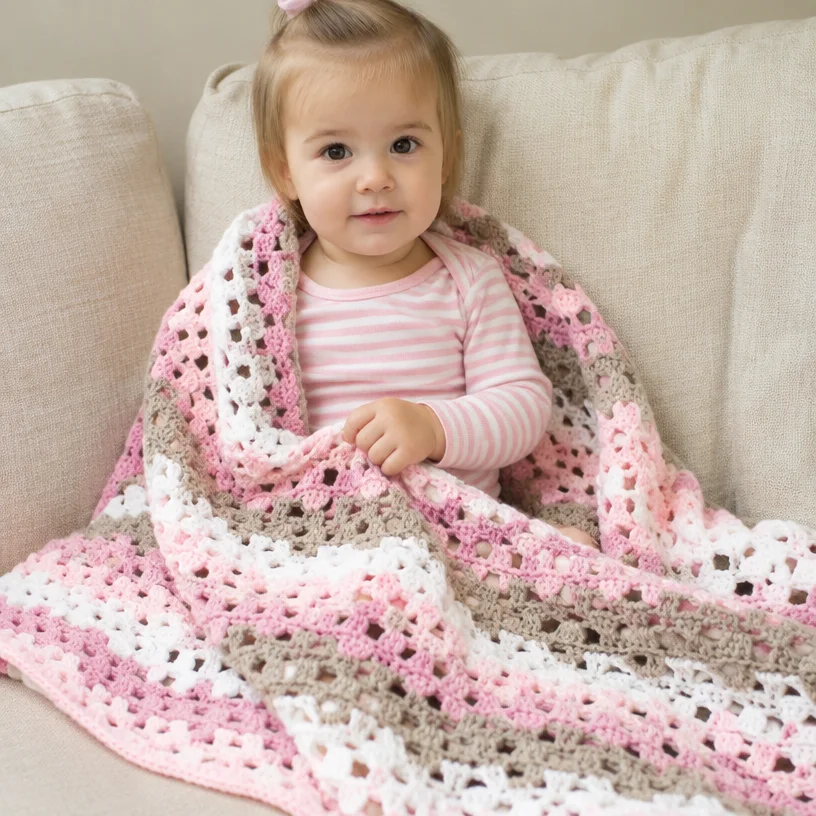
This crochet baby blanket combines soft pastel colors with a lively sequence of openwork, shells, clusters, and V-stitches. The repeating stripe pattern keeps the project interesting while the rows remain manageable, making it a thoughtful handmade gift for a new baby, a nursery accent, or a cozy keepsake for everyday use.
Thank you for reading this post, don't forget to subscribe!Why you’ll love this pattern
The Be My Crochet Baby Blanket Pattern is appealing because it offers plenty of stitch variety without requiring complicated shaping. You will practice double crochet, half double crochet worked through the back loop, single crochet, clusters, shells, and V-stitches as the blanket develops.
Other benefits include:
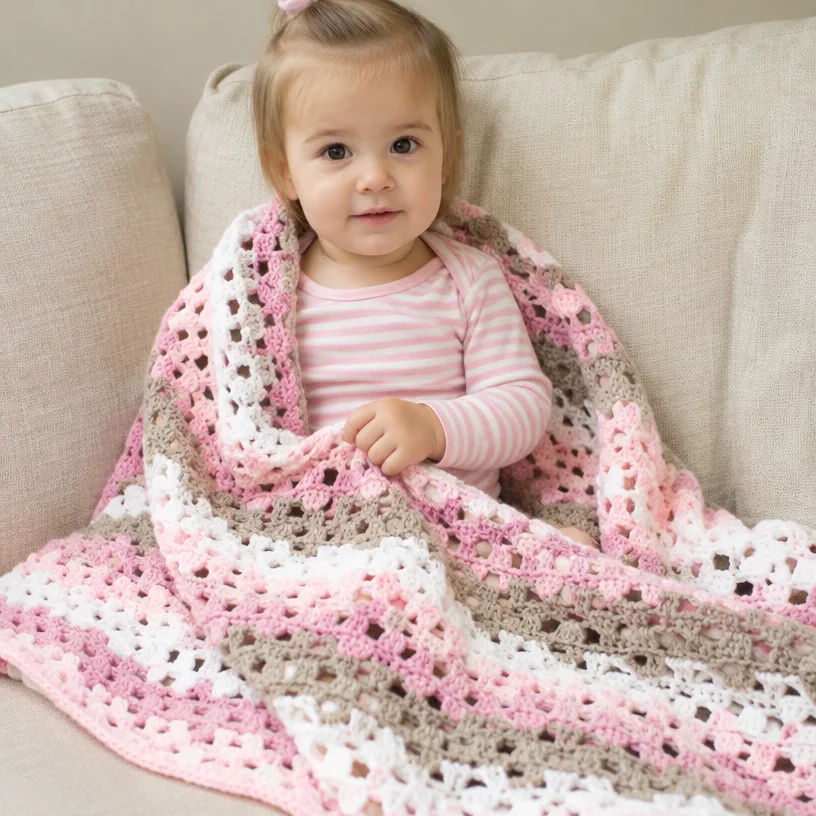
- A structured color sequence: Two rows in each color create clear, attractive stripes.
- Useful skill building: The pattern teaches color changes, carried yarn, openwork, and stitch counting.
- A thoughtful handmade gift: The soft color palette works well for baby showers, birthdays, and nursery décor.
- Portable construction: The blanket is worked in rows, so it is easy to take along as it grows.
- A polished finish: The two-round border frames the textured center and gives the edges a more finished appearance.
“I loved how each stripe introduced a different stitch pattern. The color changes made the blanket feel special, but the instructions were easy to follow once I established the repeat.”
Pattern overview
This blanket is worked flat in rows, beginning with a foundation chain of 120 stitches. The first two rows establish the base. Rows 3 through 14 then create the main stitch sequence, moving through open spaces, clusters, V-stitches, shells, and solid double crochet.
The color sequence is:
- Two rows with Contrast A
- Two rows with Contrast B
- Two rows with Contrast C
- Two rows with Contrast D
These eight rows form the stripe pattern. After the first 14 rows, the stitch sequence is repeated through Row 72. A two-round border is added afterward.
The pattern is best suited to an intermediate crocheter or an adventurous beginner who is comfortable reading abbreviations and counting stitches. The total completion time will depend on your tension, crochet speed, and how often you work on the blanket.
Materials you’ll need
- Red Heart® Crème de la Creme™, 2.5 oz/71 g; 126 yds/115 m per ball:
- Contrast A, Dark Linen (0350): 3 balls
- Contrast B, Orchid Pink (0701): 3 balls
- Contrast C, White (0001): 2 balls
- Contrast D, Pale Pink (0710): 3 balls
- Size U.S. H/8, 5 mm crochet hook, or the size needed to obtain gauge
- Yarn needle
Red Heart Crème de la Creme is a smooth cotton yarn. Use the same yarn weight and a similar fiber if substituting. A different yarn can change the blanket’s size, drape, texture, and yardage requirements, so make a gauge swatch before beginning.
Step-by-step instructions
Abbreviations and notes
The pattern uses these common abbreviations:
- ch: chain
- sc: single crochet
- hdc: half double crochet
- dc: double crochet
- sl st: slip stitch
- sp: space
- st: stitch
- rep: repeat
- beg: beginning
- RS: right side
- hdcbl: half double crochet through the back loop
- dc2tog: double crochet two together
- Cl: cluster
- V-st: V-stitch
For a color change, work the current stitch until two loops remain on the hook. Draw the new color through those final two loops, then continue with the new color.
Do not cut the unused yarn. Carry it along the side edge of the work. Keep the carried strands loose enough that the edge does not pull inward.
The stripe pattern is:
- 2 rows with A
- 2 rows with B
- 2 rows with C
- 2 rows with D
These eight rows form the Stripe Pattern.
Crochet the blanket
-
Begin the foundation chain.
With Contrast A, chain 120. -
Work Row 1.
With the right side facing, make 1 double crochet in the 4th chain from the hook; this turning chain counts as 2 double crochets. Make 1 double crochet in each chain to the end. Turn.
You should have 118 dc. -
Work Row 2.
Chain 1. Make 1 half double crochet through the back loop of each stitch to the end of the row. Join Contrast B. Turn.
You should have 118 hdc. -
Work Row 3.
Chain 1. Make 1 single crochet in each of the first 2 hdc.
Repeat the following sequence across the row: chain 2, skip the next 2 hdc, and make 1 single crochet in each of the next 2 hdc. Turn.
You should have 60 sc and 29 ch-2 spaces. -
Work Row 4.
Begin with a double crochet two together.
Repeat across the row: chain 1, work a 4-double-crochet cluster in the next chain-2 space, chain 1, and work a double crochet two together. Join Contrast C. Turn.
You should have 30 dc2tog and 29 4-dc clusters. -
Work Row 5.
Chain 1. Make 1 single crochet in the first dc2tog.
Repeat across the row: chain 1, 1 single crochet in the next 4-dc cluster, chain 1, and 1 single crochet in the next dc2tog. Turn.
You should have 59 sc and 58 ch-1 spaces. -
Work Row 6.
Begin with a V-stitch. Work 1 V-stitch in each single crochet across the row. Join Contrast D. Turn.
You should have 59 V-stitches. -
Work Row 7.
Slip stitch into the chain-1 space of the first V-stitch. Chain 3; this counts as the first double crochet. Make 1 double crochet in the same space as the slip stitch.
Repeat across the row: chain 2, make 1 single crochet in the chain-1 space of the next V-stitch, chain 2, and make 2 double crochets in the chain-1 space of the following V-stitch. Turn.
You should have 30 groups of 2 dc and 29 sc. -
Work Row 8.
Chain 1. Make 1 single crochet in the first double crochet.
Repeat to the last 2-dc group: chain 4 and make 1 single crochet in the first double crochet of the next 2-dc group.
Chain 4, then make 1 single crochet in the top of the beginning chain. Join Contrast A. Turn.
You should have 30 sc and 29 ch-4 spaces. -
Work Row 9.
Chain 3. Work 1 shell in each chain-4 space until the last single crochet. Make 1 double crochet in the last single crochet. Turn.
You should have 29 shells. -
Work Row 10.
Chain 1. Make 1 single crochet in the first double crochet, then chain 2. Make 1 single crochet in the chain-2 space of the first shell.
Repeat across the row: chain 2, 1 single crochet in the first double crochet of the next shell, chain 2, and 1 single crochet in the chain-2 space of that same shell.
Make 1 single crochet in the top of the beginning chain-3. Join Contrast B. Turn.
You should have 59 sc. -
Work Row 11.
Begin with a V-stitch. Work 1 V-stitch in each single crochet across the row. Turn.
You should have 59 V-stitches. -
Work Row 12.
Chain 3. Make 1 double crochet in the chain-1 space of the first V-stitch. Work 2 double crochets in the chain-1 space of each V-stitch to the last V-stitch. Make 1 double crochet in the chain-1 space of the last V-stitch. Make 1 double crochet in the 3rd chain of the beginning chain-4 of the V-stitch. Join Contrast C. Turn.
You should have 118 stitches. -
Work Row 13.
Chain 3. Working in back loops only, make 1 double crochet in each stitch across the row. Turn. -
Work Row 14.
Work the same instructions as Row 2. Join Contrast D. -
Continue the stripe pattern.
Work Rows 15 through 72 as follows: repeat Rows 3 through 14 four more times, then work Rows 3 through 12 once. Fasten off.
Add the border
-
Work Border Round 1.
With the right side facing, join Contrast A with a slip stitch in the last stitch. Chain 1. Work 3 half double crochets in the same space as the slip stitch to form the first corner.Work 153 half double crochets evenly down the left side of the blanket. Work 3 half double crochets in the corner. Make 1 half double crochet in each chain across the foundation chain to the next corner. Work 3 half double crochets in that corner.
Work 153 half double crochets evenly up the right side of the blanket. Work 3 half double crochets in the next corner. Make 1 half double crochet in each hdc across the top edge to the end of the round.
Join with a slip stitch in the first hdc. Fasten off.
-
Work Border Round 2.
Join Contrast D with a slip stitch in the center hdc of any corner. Chain 3, then make 1 double crochet in the same space as the slip stitch.Repeat around the blanket: chain 2, skip the next hdc, make 1 single crochet in the next hdc, chain 2, slip stitch in the next hdc, and make 2 double crochets in the next hdc.
When 2 hdc remain before the beginning point, skip the next hdc, chain 2, and join with a slip stitch in the top of the beginning chain-3. Fasten off.
-
Finish the blanket.
Thread the yarn needle with each loose end and weave the ends securely into the wrong side of the blanket. Trim only after the ends are firmly woven in.
Ways to use your finished project
This crochet baby blanket is especially suited to:
- A baby shower or newborn gift
- A nursery throw for a crib, rocking chair, or reading corner
- A lightweight lap blanket for supervised cuddling
- A handmade heirloom to save for a child
- A soft photo prop when used safely and with adult supervision
- A coordinated nursery set when paired with matching crochet baskets or small accessories
For babies, never leave a loose blanket unattended in a crib or sleeping area. Follow current safe-sleep guidance and use the blanket only when an adult is supervising.
How to care for your crochet project
Check the yarn label before washing, as care instructions can vary. For a cotton blanket, gentle machine washing or hand washing may be suitable, but avoid assuming that every cotton blend has the same care requirements.
- Wash with mild detergent in cool or lukewarm water.
- Use a gentle cycle if machine washing is allowed on the label.
- Avoid bleach and harsh fabric softeners.
- Support the blanket when wet so its weight does not stretch the stitches.
- Reshape the edges and corners while damp.
- Dry flat on a clean towel or drying surface.
- Avoid hanging the blanket to dry, as this can distort the border.
- Store it completely dry in a breathable space.
- Keep it away from direct sunlight for long periods to help reduce fading.
- If pilling appears, remove pills carefully with a fabric shaver rather than pulling them by hand.
Tips for success
- Make a gauge swatch. The recommended hook is 5 mm, but your tension may require a different size.
- Count after every pattern row. The stitch counts change between solid and openwork rows, so checking prevents errors from carrying forward.
- Use stitch markers. Mark the first and last stitch of long rows, especially while learning the pattern.
- Keep carried yarn loose. Tight carried strands can cause the side edge to pucker.
- Watch the turning chain. The pattern states when a chain counts as a stitch. Treat it consistently.
- Identify V-stitches clearly. A V-stitch is generally made as a double crochet, chain 1, and double crochet in the same stitch or space. Keep each pair in the correct space.
- Do not skip the back-loop detail. Row 2 and Row 13 use specific working locations that create texture and help define the pattern.
- Check the edges before continuing. If the sides begin to slant, compare your work with the row stitch counts before adding more rows.
- Join colors neatly. Change colors through the final two loops of the stitch so the transition stays clean.
- Block gently if needed. Light blocking can open the lace sections and straighten the border, but avoid stretching the blanket aggressively.
Customize your project
You can personalize the blanket while keeping its original stitch sequence.
- Change the color palette: Replace the pinks with blue, sage, lavender, neutral, or rainbow shades. Keep four contrasting colors to preserve the stripe rhythm.
- Use a single color: A monochromatic version will emphasize the stitch textures rather than the stripes.
- Create a gender-neutral palette: Combine cream, taupe, soft green, pale yellow, and white.
- Change the border color: Use Contrast D for a subtle finish or a dark shade for stronger definition.
- Adjust the length: Repeat the 3rd-through-14th-row sequence to make the blanket longer. More repeats require additional yarn.
- Adjust the width carefully: A different foundation-chain length may disrupt the stitch repeats and side-edge alignment. Test the repeat before changing the starting chain.
- Add a simple embellishment: A small embroidered initial or restrained appliqué can personalize the blanket, but secure every decoration firmly.
- Use a different yarn fiber: Acrylic may create a lighter, easy-care blanket, while wool can provide warmth. Either substitution may change drape, washing instructions, gauge, and yarn quantity.
Frequently asked questions
Is this crochet baby blanket beginner-friendly?
It is suitable for an adventurous beginner who knows basic stitches and is willing to learn clusters, shells, V-stitches, and color changes. The stitch sequence is more involved than a simple single-crochet blanket, so careful counting is important.
What yarn works best for this pattern?
The specified yarn is Red Heart® Crème de la Creme™, with the listed amounts in Dark Linen, Orchid Pink, White, and Pale Pink. Choose a yarn with a similar weight and fiber if substituting, and make a gauge swatch before starting.
Can I use a different crochet hook?
Yes. Use the hook size needed to obtain the correct gauge and fabric feel. A smaller hook creates denser fabric, while a larger hook creates a looser, more open fabric. Either change can affect the finished size and yarn usage.
How much yarn do I need?
You need 3 balls of Contrast A, 3 balls of Contrast B, 2 balls of Contrast C, and 3 balls of Contrast D. Each ball is listed as 2.5 oz/71 g and 126 yds/115 m.
How can I make the blanket longer?
Repeat the established 3rd-through-14th-row sequence after Row 14. Additional repeats will increase the length and require more yarn. Keep the stripe order consistent for an even color rhythm.
How can I make it wider?
The foundation chain is 120 chains and produces 118 stitches in the first row. Changing the width may require adapting the chain count to suit the stitch repeats and border placement. Make a small test section before committing to a new width.
Why are my blanket edges curling or puckering?
Curling can result from tight tension, overly tight carried yarn, missed stitches, or uneven edge stitches. Check your stitch counts, loosen the carried strands, and block the finished blanket gently if necessary.
How do I keep the side edges even?
Work the first and last stitches carefully, count each row, and confirm whether the beginning chain counts as a stitch. Mark the edge stitches if they are difficult to identify.
How should I wash the finished blanket?
Follow the yarn-label instructions. In general, use cool or lukewarm water, mild detergent, gentle handling, and flat drying. Support the blanket while wet to prevent stretching.
Can I sell blankets made from this pattern?
The provided pattern information does not state the designer’s policy on selling finished items. Check the original designer or publisher’s usage terms before listing finished blankets for sale.