Crochet Baby Blanket Pattern: Be My Edition
This post may contain affiliate links. If you buy through them we may earn a small commission at no extra cost to you. Learn more.
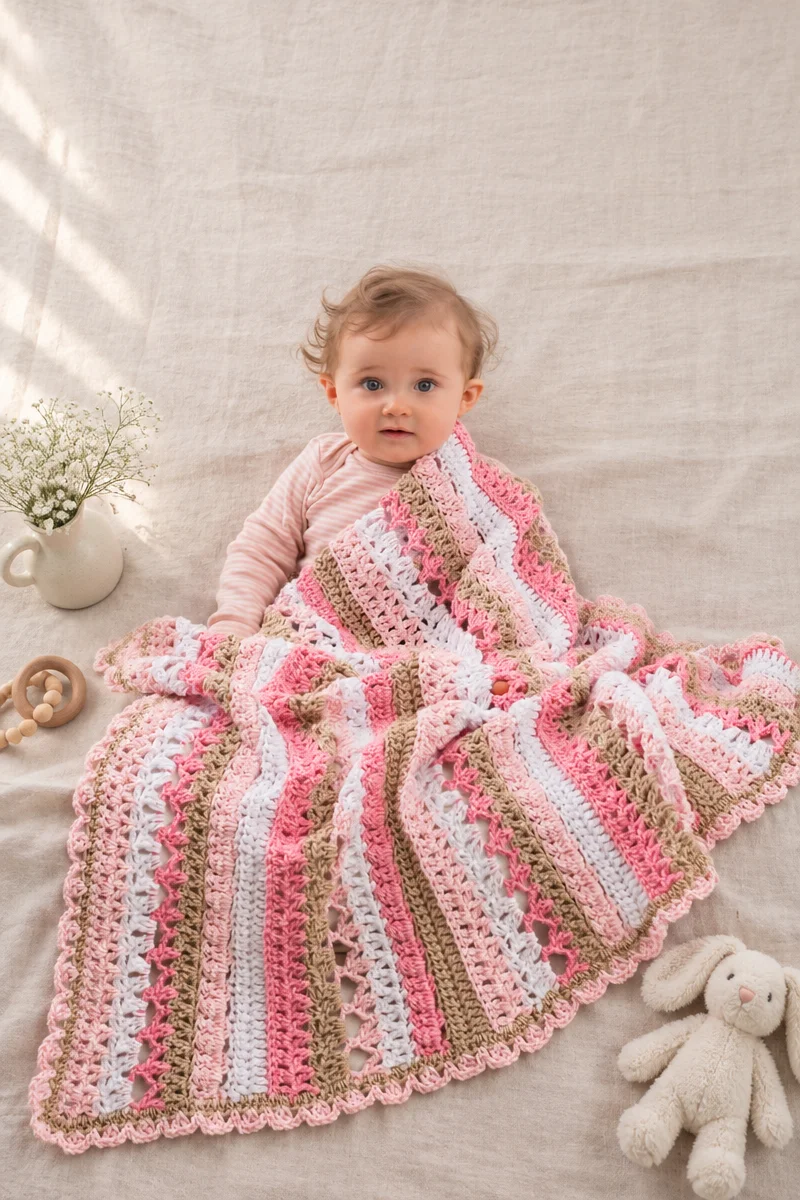
This crochet baby blanket combines soft pastel shades with eye-catching texture, making it a thoughtful handmade gift for a new arrival. The pattern moves through shells, V-stitches, clusters, and openwork rows, so it stays interesting without requiring complicated shaping. It is a rewarding project for confident beginners and experienced crocheters alike, especially for baby showers, nursery décor, or quiet weekend stitching.
Thank you for reading this post, don't forget to subscribe!Why you’ll love this pattern
- A beautiful color rhythm: The four-color stripe pattern creates gentle movement across the blanket.
- Useful stitch practice: You will work double crochet, half double crochet through the back loop, single crochet, V-stitches, shells, clusters, and decreases.
- A thoughtful handmade gift: The soft palette suits baby boys, baby girls, and gender-neutral nurseries.
- Engaging but portable: The blanket is worked in rows, making it easy to carry and complete in manageable sections.
- A polished finish: The two-round border frames the openwork body and gives the blanket a finished edge.
“I loved how each stripe introduced a new stitch without making the blanket feel overwhelming. The color changes were easy to manage, and the border really brought everything together.”
How this crochet blanket comes together
The blanket is crocheted flat in rows, beginning with Contrast A and a foundation chain of 120. The first rows establish a sturdy base, followed by repeating sections of openwork and textured stitches.
The pattern uses an eight-row stripe sequence:
- Two rows with Contrast A.
- Two rows with Contrast B.
- Two rows with Contrast C.
- Two rows with Contrast D.
The stitch design changes throughout the first 14 rows, then those instructions are repeated to create the remaining length. The project finishes with two border rounds worked around all four sides.
The main techniques include color changes, carrying unused yarn along the side edge, working into chain spaces, making V-stitches and shells, and working a double crochet two together decrease. The pattern is suitable for an advanced beginner who is comfortable reading abbreviations and counting stitches. Because the blanket contains several stitch patterns, allow enough time to work carefully rather than rushing through the repeats.
Materials you’ll need
- Red Heart® Crème de la Creme™, 2.5 oz/71 g, 126 yds/115 m per ball:
- Contrast A: Dark Linen (0350), 3 balls
- Contrast B: Orchid Pink (0701), 3 balls
- Contrast C: White (0001), 2 balls
- Contrast D: Pale Pink (0710), 3 balls
- U.S. H/8 [5 mm] crochet hook, or the size needed to obtain gauge
- Yarn needle
The listed yarn is a smooth cotton yarn, which works well for defined stitch patterns and baby items. Always check the yarn label before washing the finished blanket. If you substitute yarn, choose a similar weight and fiber. A different yarn can change the blanket’s size, drape, thickness, and yardage requirements.
Step-by-step instructions
Abbreviations and stitch notes
The pattern uses these common abbreviations:
- ch: chain
- sc: single crochet
- hdc: half double crochet
- dc: double crochet
- sl st: slip stitch
- sp: space
- st: stitch
- RS: right side
- beg: beginning
- rep: repeat
- cont: continue
Additional stitch terms:
- hdcbl: half double crochet worked through the back loop
- V-st: one double crochet, chain 1, and one double crochet worked in the same stitch or space
- 4-dc Cl: four double crochets worked together as one cluster
- dc2tog: double crochet two together
- Shell: the shell stitch specified by the pattern; work the required group of double crochets into the indicated chain space
Color changes and stripe sequence
When changing color, work the stitch until two loops remain on the hook. Draw the new color through those final two loops, then continue with the new color.
Do not cut the yarn after each color change. Carry the unused color neatly along the side edge of the work. Keep the carried strands loose enough that the edge does not pull or pucker.
Follow this stripe pattern throughout the blanket:
- Two rows with A
- Two rows with B
- Two rows with C
- Two rows with D
These eight rows form one complete stripe repeat.
Work the blanket
-
With Contrast A, chain 120.
-
First row, right side: Work 1 double crochet in the fourth chain from the hook. The skipped chains count as 2 double crochets. Work 1 double crochet in each chain to the end. Turn. You should have 118 dc.
-
Second row: Chain 1. Work 1 half double crochet through the back loop of each stitch across. Join Contrast B. Turn. You should have 118 hdc.
-
Third row: Chain 1. Work 1 single crochet in each of the first 2 half double crochets.
Repeat the following across the row: chain 2, skip the next 2 half double crochets, and work 1 single crochet in each of the next 2 half double crochets.
Turn. You should have 60 sc and 29 ch-2 spaces. -
Fourth row: Begin with a double crochet two together.
Repeat across the row: chain 1, work a 4-double-crochet cluster in the next chain-2 space, chain 1, and work a double crochet two together.
Join Contrast C and turn. You should have 30 dc2tog and 29 4-dc clusters. -
Fifth row: Chain 1. Work 1 single crochet in the first double crochet two together.
Repeat across the row: chain 1, 1 single crochet in the next 4-double-crochet cluster, chain 1, and 1 single crochet in the next double crochet two together.
Turn. You should have 59 sc and 58 ch-1 spaces. -
Sixth row: Begin a V-stitch. Work 1 V-stitch in each single crochet across. Join Contrast D and turn. You should have 59 V-stitches.
-
Seventh row: Slip stitch into the chain-1 space of the first V-stitch. Chain 3; this counts as the first double crochet. Work 1 double crochet in the same space as the slip stitch.
Repeat across the row: chain 2, 1 single crochet in the chain-1 space of the next V-stitch, chain 2, and 2 double crochets in the chain-1 space of the next V-stitch.
Turn. You should have 30 groups of 2 dc and 29 sc. -
Eighth row: Chain 1. Work 1 single crochet in the first double crochet.
Repeat across to the last 2-double-crochet group: chain 4, then 1 single crochet in the first double crochet of the next 2-double-crochet group.
At the end, chain 4 and work 1 single crochet in the top of the beginning chain. Join Contrast A and turn. You should have 30 sc and 29 ch-4 spaces. -
Ninth row: Chain 3. Work 1 shell in each chain-4 space to the last single crochet. Work 1 double crochet in the last single crochet. Turn. You should have 29 shells.
-
Tenth row: Chain 1. Work 1 single crochet in the first double crochet, chain 2, and 1 single crochet in the chain-2 space of the first shell.
Repeat across: chain 2, 1 single crochet in the first double crochet of the next shell, chain 2, and 1 single crochet in the chain-2 space of that same shell.
Work 1 single crochet in the top of the beginning chain-3. Join Contrast B and turn. You should have 59 sc. -
Eleventh row: Begin a V-stitch. Work 1 V-stitch in each single crochet across. Turn. You should have 59 V-stitches.
-
Twelfth row: Chain 3. Work 1 double crochet in the chain-1 space of the first V-stitch. Work 2 double crochets in the chain-1 space of each V-stitch to the last V-stitch. Work 1 double crochet in the chain-1 space of the last V-stitch, then 1 double crochet in the third chain of the beginning chain-4 of the V-stitch. Join Contrast C and turn. You should have 118 stitches.
-
Thirteenth row: Chain 3. Working through back loops only, work 1 double crochet in each stitch across. Turn.
-
Fourteenth row: Work the same instructions as the second row. Join Contrast D.
-
Rows 15–72: Continue the established stripe pattern by working rows 3–14 four more times, then work rows 3–12 once more. Fasten off.
Add the border
-
Turn the blanket so the right side is facing. Join Contrast A with a slip stitch in the last stitch.
-
First border round: Chain 1. Work 3 half double crochets in the same space as the slip stitch; this forms the first corner.
Work 153 hdc evenly spaced down the left side of the blanket. Work 3 half double crochets in the corner.
Work 1 half double crochet in each chain across the foundation chain to the next corner. Work 3 half double crochets in that corner.
Work 153 hdc evenly spaced up the right side. Work 3 half double crochets in the next corner.
Work 1 half double crochet in each half double crochet across the top edge to the end of the round. Join with a slip stitch in the first half double crochet. Fasten off. -
Second border round: Join Contrast D with a slip stitch in the center half double crochet of any corner. Chain 3; this counts as the first double crochet. Work 1 double crochet in the same space as the joining slip stitch.
-
Repeat around the blanket: chain 2, skip the next half double crochet, work 1 single crochet in the next half double crochet, chain 2, slip stitch in the next half double crochet, and work 2 double crochets in the next half double crochet.
-
Near the end of the round, skip the next half double crochet, chain 2, and join with a slip stitch in the top of the beginning chain-3. Fasten off.
-
Use a yarn needle to weave in all remaining ends securely. Trim excess yarn only after the ends are firmly woven into the fabric.
Ways to use your finished blanket
- Give it as a baby-shower or newborn gift.
- Fold it over the arm of a nursery chair for a decorative accent.
- Use it as a lightweight stroller or car-seat blanket under supervision.
- Coordinate it with a handmade baby hat, lovey, or pillow.
- Photograph it as part of a newborn gift basket.
- Make a second blanket in a different palette for a matching sibling set.
For safety, never leave a loose blanket, yarn end, or other soft item unattended with a sleeping infant. Follow current safe-sleep guidance when using handmade baby items.
How to care for your crochet project
Red Heart® Crème de la Creme™ is cotton, but care instructions can vary by yarn line and color. Check the label on the actual balls used and follow those directions first.
For gentle maintenance:
- Wash in cool or lukewarm water.
- Use a mild detergent and avoid bleach unless the label specifically permits it.
- Choose a gentle cycle or hand wash setting.
- Avoid wringing, twisting, or pulling the blanket.
- Reshape it while damp and dry it flat on a clean surface.
- Keep the blanket away from high heat, which can cause cotton to shrink or lose its shape.
- Store it completely dry, folded loosely in a breathable cupboard or drawer.
- Avoid storing it in plastic for long periods, as trapped moisture can cause odors or mildew.
- Wash dark and light colors separately the first time if you are concerned about color transfer.
Helpful tips for success
- Make a gauge swatch. The pattern specifies a 5 mm hook or the size needed to obtain gauge. A different tension can alter the finished dimensions.
- Count after every pattern section. The stitch counts help confirm that clusters, skips, and V-stitches are positioned correctly.
- Mark the first and last stitch. Openwork rows can make edge stitches easy to miss.
- Keep carried yarn relaxed. Tight floats along the side edge can make the blanket narrower or cause puckering.
- Watch the turning chain. The beginning chain counts as a stitch where stated, especially in the double crochet rows.
- Identify chain spaces clearly. V-stitches, shells, and clusters are worked into spaces rather than always into the tops of stitches.
- Check your row count. The main body ends after row 72 before the border is added.
- Use the side edge as a guide. The first border round requires 153 evenly spaced half double crochets on each side. Distribute them gradually instead of placing them all at the corners.
- Keep corners consistent. Each corner in the first border round uses 3 hdc in the corner space.
- Weave in ends before washing. Secure ends on the wrong side so they do not loosen during laundering.
Customize your project
Change the color palette
The original combination of Dark Linen, Orchid Pink, White, and Pale Pink creates a soft, vintage-inspired look. You can replace the colors with:
- Sage, cream, dusty blue, and blush
- Gray, white, lavender, and rose
- Navy, ivory, mustard, and pale gray
- Several shades of one color for an ombré effect
Keep the same contrast between colors if you want the stitch pattern to remain easy to see.
Make the blanket wider or narrower
The foundation chain is 120 chains, and the stitch pattern relies on specific repeat structures. Any width adjustment should preserve the pattern’s stitch multiples and edge setup. Changing the starting chain will also alter the amount of yarn required.
Make it longer
Repeat additional 8-row stripe sequences to add length. Make sure the final section ends at a visually suitable point before adding the border. Extra rows will require additional yarn.
Use a contrasting border
A dark border can define a pale blanket, while white or cream can give a brighter finish. Changing the border color will affect the overall appearance but not the construction.
Add simple personalization
After the blanket is complete, you can embroider a small initial or add a carefully secured appliqué. Avoid loose embellishments on items intended for babies, and make sure any decoration is firmly attached.
Change the yarn
A similar-weight cotton yarn can preserve the stitch definition and breathable feel. A thicker yarn will produce a heavier, larger blanket and may require a larger hook. A thinner yarn will make a lighter, potentially smaller blanket. Always make a gauge swatch before committing to the full project.
Frequently asked questions
Is this crochet baby blanket beginner-friendly?
It is best suited to an advanced beginner or intermediate crocheter. The individual stitches are common, but the pattern changes between several stitch sections and requires careful counting.
What yarn works best for this blanket?
The pattern calls for Red Heart® Crème de la Creme™ in four colors. A smooth cotton yarn of similar weight is the safest substitute because it provides clear stitch definition and a comfortable drape.
Can I use a different crochet hook?
Yes, use the hook size needed to obtain gauge. A larger hook may create a looser, larger fabric, while a smaller hook may produce a denser, smaller blanket.
How much yarn is required?
The pattern uses 3 balls each of Contrasts A, B, and D, plus 2 balls of Contrast C. That is 11 balls total. Substitutions may require more or less yarn depending on yardage and tension.
How can I make the blanket larger?
Add length by repeating additional stripe sections, but keep the color sequence consistent and finish at a suitable point before working the border. Increasing the width requires adjusting the foundation chain while preserving the pattern’s stitch structure.
Why are my blanket edges uneven?
Uneven edges usually come from missing the first or last stitch, working into the wrong chain space, or tightening the carried yarn. Use stitch markers, count each row, and keep your tension steady.
Why is the fabric curling?
A small amount of curling can happen during construction, particularly with changing stitch patterns. Check your tension, confirm that the stitch counts are correct, and gently reshape or block the completed blanket.
How do I keep the color changes neat?
Change color through the final two loops of the preceding stitch, as directed. Carry unused colors along the side without pulling them tight, and cover the edge with the border.
Can I sell blankets made from this pattern?
The supplied pattern information does not state its licensing or selling terms. Check the original designer or publisher’s usage policy before selling finished items, and credit the pattern source where required.
How should I wash the finished blanket?
Follow the care label for the yarn used. In general, gentle washing in cool or lukewarm water, followed by reshaping and flat drying, is the safest approach for a cotton crochet blanket.