Crochet Blanket Pattern: Bands of Color
This post may contain affiliate links. If you buy through them we may earn a small commission at no extra cost to you. Learn more.
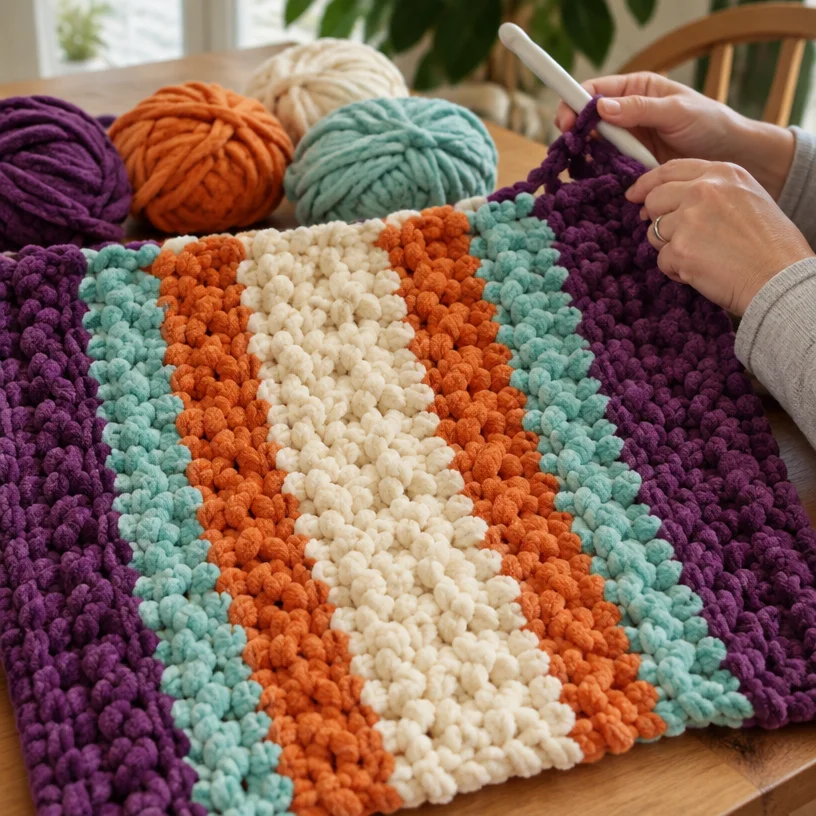
This Bands of Color crochet blanket is a cheerful, beginner-friendly project made with super-bulky yarn, a large hook, and an easy moss stitch. The repeating bands of grape, teal, canyon, and foam create a modern striped look without complicated shaping. It is a relaxing choice for a weekend-style crochet project, a cozy home accent, or a handmade gift.
Thank you for reading this post, don't forget to subscribe!Why you’ll love this pattern
- Easy stitch pattern: The moss stitch uses single crochet and chain-1 spaces, making it accessible to newer crocheters.
- Bold color changes: The planned stripe sequence creates visual interest while keeping the construction simple.
- Fast-growing fabric: The 25 mm hook and bulky yarn help the blanket build quickly.
- Relaxing repetition: Once the setup is complete, the same row structure is repeated.
- Useful handmade gift: The finished blanket can make a thoughtful present for a new home, birthday, holiday, or cozy movie-night gift.
- Easy to customize: You can change the stripe colors or repeat the pattern for a different size.
“The moss stitch was easy to memorize, and the large hook made this blanket grow surprisingly fast. The color bands give it a polished look even though the construction is very simple.”
How this crochet pattern comes together
You will crochet a striped blanket in rows, beginning with a foundation chain of 36 chains. The first row establishes the chain-1 spaces used by the moss stitch. You then work the moss stitch in rows while following a 24-row color sequence.
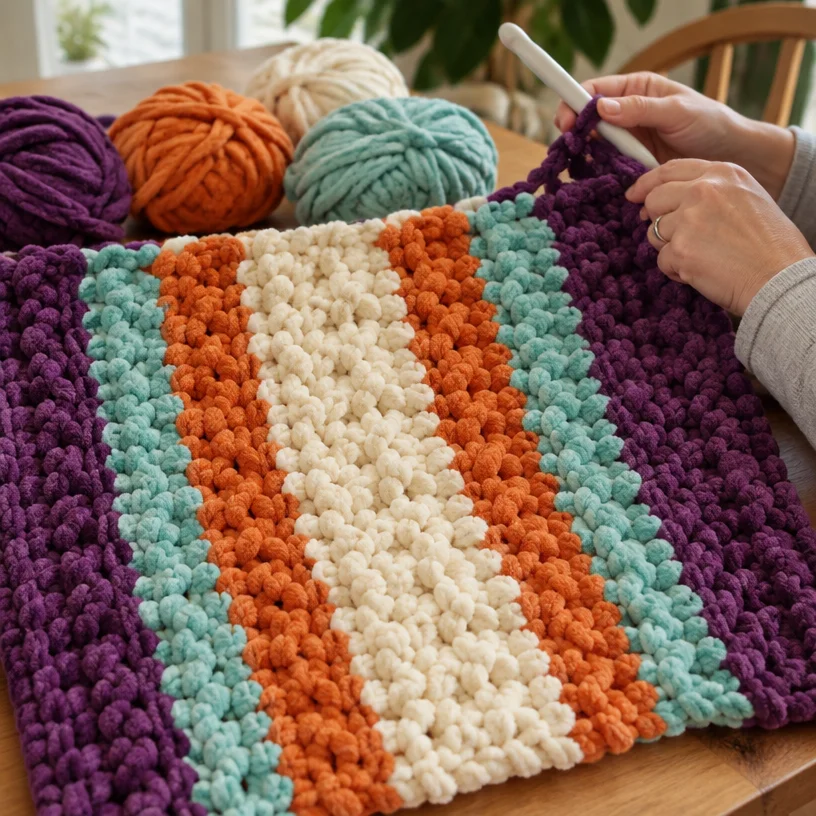
The stripe pattern uses short three-row color sections, with one six-row section in Contrast D. After the color sequence is complete, the 24-row stripe pattern can be repeated according to the instructions provided. The project is suitable for beginners who are comfortable with single crochet, chain stitches, turning rows, and changing colors.
Because the pattern uses super-bulky yarn and a U/50 hook, the fabric should grow quickly. Your actual completion time will depend on your tension, crochet speed, and whether you repeat the stripe sequence for a larger blanket.
Materials you’ll need
- Bernat® Blanket Big Mist-ical™
- 10.5 oz/300 g
- 32 yds/29 m
- Quantity not specified
- Contrast A: Grape Mix, 32015 — 2 balls or 69 yds/63 m
- Contrast B: Misty Teal, 32007 — 2 balls or 62 yds/57 m
- Contrast C: Canyon, 32009 — 2 balls or 58 yds/53 m
- Contrast D: Foam, 32001 — 2 balls or 62 yds/57 m
- Susan Bates® crochet hook, size U/50 (25 mm), or size needed to obtain gauge
- Susan Bates® yarn needle
Bernat Blanket Big is a very thick yarn, so confirm the yarn label before substituting. A different yarn weight can change the blanket’s width, drape, texture, and yarn requirements. If you use another super-bulky yarn, make a small sample first and compare the fabric before beginning.
Step-by-step instructions
Abbreviations and stitch terms
- ch: chain
- sc: single crochet
- sp: space
- rep: repeat
- cont: continue
- Moss stitch: alternating single crochet stitches and chain-1 spaces
Stripe sequence
The following 24-row sequence forms the Stripe Pattern:
- With Contrast A, work 3 rows. Join Contrast B and break Contrast A.
- With Contrast B, work 3 rows. Join Contrast C and break Contrast B.
- With Contrast C, work 3 rows. Join Contrast D and break Contrast C.
- With Contrast D, work 6 rows. Join Contrast C and break Contrast D.
- With Contrast C, work 3 rows. Join Contrast B and break Contrast C.
- With Contrast B, work 3 rows. Join Contrast A and break Contrast B.
- With Contrast A, work 3 rows.
Crochet the blanket
-
Make the foundation chain.
With Contrast A, chain 36. -
Work the setup row.
Make 1 single crochet in the fourth chain from the hook. This chain counts as 1 single crochet.Chain 1, then make 1 single crochet.
Continue across the foundation chain as follows:
Chain 1, skip the next chain, and make 1 single crochet in the next chain.
Repeat from the asterisk to the end of the chain. Turn.
You should have 35 stitches total, including 18 single crochet stitches.
-
Begin the moss stitch.
Chain 2. This counts as 1 single crochet and chain 1.Skip the first single crochet. Make 1 single crochet in the next chain-1 space.
Continue across the row:
Chain 1, skip the next single crochet, and make 1 single crochet in the next chain-1 space.
Repeat from the asterisk to the last single crochet. Turn.
This row forms the Moss Stitch Pattern. The setup row and this first moss stitch row complete the first 2 rows of the Stripe Pattern.
-
Continue the stripe sequence.
Keeping the color order established above, repeat the moss stitch row while following the Stripe Pattern. Change colors at the points listed in the 24-row stripe sequence. -
Complete the stripe pattern.
Continue repeating the last moss stitch row until all 24 rows of the Stripe Pattern are complete. -
Finish the blanket.
Fasten off. Use a yarn needle to weave in the loose ends securely on the wrong side of the blanket.
The original chart shows a reduced sample of the Moss Stitch Pattern. Its stitch key identifies a circle as a chain and a vertical stroke as a single crochet.
Ways to use your finished project
- Drape it over the back of a sofa or armchair as a colorful home accent.
- Fold it at the foot of a bed for extra warmth and decoration.
- Use it as a cozy lap blanket while reading or watching television.
- Give it as a handmade housewarming, birthday, or holiday gift.
- Coordinate the colors with a nursery, guest room, or seasonal décor.
- Make several blankets in different palettes for a matching handmade collection.
How to care for your crochet project
Bernat Blanket yarn is commonly made from polyester, but always check the label on your specific yarn for exact washing instructions.
- Follow the yarn label’s recommended water temperature and washing method.
- Use a gentle cycle and mild detergent if machine washing is allowed.
- Avoid bleach and harsh chemicals.
- Support the blanket when removing it from the washer, since wet yarn can become heavy.
- Reshape the blanket while damp and dry it flat when possible.
- Avoid hanging it while wet, as the weight may stretch the stitches.
- Keep it away from rough surfaces that can increase pilling.
- Store it clean and completely dry in a breathable storage container.
- Do not place heavy objects on top of it for long periods, which can flatten the textured stitch pattern.
Tips for success
- Check your tension early. A 25 mm hook creates a loose, flexible fabric, but tight crocheters may still produce a denser result.
- Use stitch markers if needed. Place one in the first and last stitch of a row to help prevent accidental increases or decreases.
- Count the setup row carefully. The foundation chain and skipped chains establish the chain-1 spaces used throughout the blanket.
- Look for the spaces, not only the stitches. In moss stitch, the single crochets are worked into chain-1 spaces on the following row.
- Keep the edges straight. Make sure the first and last stitch of every row are worked exactly as instructed.
- Change colors neatly. Join the next color at the end of the specified row, then weave in the tails later rather than trimming them too short.
- Do not pull the chain stitches tightly. Loose, even chains help the blanket maintain a soft drape.
- Lay the blanket flat occasionally. This makes it easier to spot an accidental increase, missing stitch, or uneven color change.
- Weave in ends securely. With thick yarn, weave each tail through several nearby stitches on the wrong side without creating a bulky knot.
Customize your project
Change the color palette
Replace the original grape, teal, canyon, and foam shades with neutrals, pastels, jewel tones, or seasonal colors. Keep the same stripe order for a similar visual rhythm, or assign new colors to each contrast position.
Make a larger or smaller blanket
The instructions begin with a chain of 36. To change the width, adjust the foundation chain while preserving the stitch pattern’s structure. A different starting chain may affect the edge pattern, so work a small test section before committing to the full blanket.
Adding more 24-row stripe repeats will increase the length. Fewer repeats will create a smaller throw or lap blanket. More rows require additional yarn.
Use a contrasting edging
The supplied instructions finish with fastening off and do not specify a border. You can add a simple single crochet border in one of the existing colors, but this will change the finished dimensions and increase yarn usage.
Create coordinating pieces
Use the same colors for a cushion cover, basket, pillow, or smaller lap blanket. Match the stripe order to create a coordinated room set, remembering that each item may need its own stitch and size calculations.
Frequently asked questions
Is this crochet blanket beginner-friendly?
Yes. The main fabric uses moss stitch, which is formed with single crochet and chain-1 spaces. Beginners should be comfortable with counting stitches, turning rows, and changing colors.
What yarn works best for this pattern?
The listed pattern uses Bernat Blanket Big Mist-ical with the specified contrast colors. A similar super-bulky yarn may work, but changing yarn can affect the blanket’s size, thickness, drape, and yardage requirements.
Can I use a different crochet hook?
Yes, but use the hook size needed to obtain the desired gauge and fabric. A smaller hook generally creates a denser fabric, while a larger hook creates a looser fabric. Either change can affect the finished size and yarn consumption.
How much yarn do I need?
The contrast colors are listed as follows: 69 yards of A, 62 yards of B, 58 yards of C, and 62 yards of D, with 2 balls specified for each. The quantity of Bernat Blanket Big Mist-ical is not specified in the provided instructions, so check the original yarn information before purchasing.
How can I make the blanket larger?
Repeat the 24-row Stripe Pattern for additional length. To increase the width, modify the foundation chain while maintaining the pattern structure and test the new stitch count before starting the full blanket.
Why are my edges uneven?
Uneven edges are often caused by missing the first or last stitch, working into the wrong chain-1 space, or accidentally adding an extra stitch. Mark the edge stitches and count regularly, especially during the first few rows.
Why is my blanket curling?
A small amount of curling can result from tight tension or tight chain stitches. Relax your grip, keep the chain-1 spaces even, and check that each row has the correct stitch placement. Blocking or gentle reshaping after finishing may also help.
How should I wash the finished blanket?
Follow the care instructions on the yarn label. Use gentle handling, avoid harsh chemicals, reshape the blanket while damp, and dry it flat when possible to reduce stretching.
Can I sell blankets made from this pattern?
The provided instructions do not state the designer’s policy regarding finished-item sales. Check the original designer or publisher’s usage terms before selling blankets made from the pattern.